Archive for category: News

Father’s tribute leads to commemorative scholarship for son and daughter

Kim Price Lapsley and Mark Price are honored with a new scholarship for Turner Ashby High School students. Both graduated from TA.

Two Turner Ashby High School students were the recipients of new scholarships offered this year in memory of a brother and sister who graduated from the Dayton school.

Local resident Joseph Price set up the awards to honor his son Mark Hamilton Price and daughter Kimberly Jo Price Lapsley. Mark graduated in 1982 and Kimberly in 1991.

“As we worked with Mr. Price, he shared memories of his children’s success at TA,” said Revlan Hill, executive director. “Mark was manager of TA’s ‘Dirty Dozen’ football team and enjoyed his classes in art. Kimberly participated on the VACE academic bowl team, fielding questions about literature and language. Turner Ashby was obviously a big influence on their lives, and it made the most sense for Mr. Price to set up a scholarship to benefit current students at the high school that had supported his children’s interests and helped them grow as students and people.”

Awardees Getsemany Pineda and Cai Johnstone-Yellin both plan to attend Massanutten Technical Center.

Donate to the Mark & Kimberly Vocational Scholarship.

Pineda, a midfielder for three years on the Knights soccer team, is heading into the electrical field, with the goal of owning a business in the future. He is planning a full schedule of courses to expedite his learning before apprenticeship, so the funding will help defray some of those costs, he said.

Asked to name someone who has inspired him through high school, Pineda named his father. “He works hard for our family and you will never see him with a sad face. He is always joyful and makes his family happy as well.”

Pineda says he is honored to be a recipient: “I really appreciate the help and will be putting it in good use for my future as an electrician. It means a lot winning this award!”

Johnstone-Yellin comes from a family of tradesmen. He plans to pursue welding. He’s taken several courses at MTC already, where a simulated workplace environment is used to prepare students for the workforce. As project manager, Johnstone-Yellin led a crew of peer “subcontractors” through several projects, earning praise from instructors.

For Joseph Price, the scholarship offers a way to remember his children while giving hope and support to a younger generation of TA graduates. He continues to miss both of his children — Mark died in 2024 and Kimberly in 2014.

Though neither his son nor daughter worked in the trades or attended vocational school, Price decided after reviewing other local scholarship offerings that creating an award for vocational education met his goals. One vocational education course has the potential to change the trajectory of a life – and offer immediate skills to apply in the labor force.

Mark, a Dayton resident, was the byproducts coordinator at Lakeside Books in Harrisonburg. He loved the outdoors, hunting, riding horses and motorcycles, as well as cooking for friends and family. His homemade barbecue sauce is still remembered and his pitchfork turkey in peanut oil was always a Thanksgiving treat. Mark was a drummer and enjoyed making and listening to music. His last dog, Zeba, was a constant companion.

Kimberly was also a musician, performing with her husband and the 100 Proof bluegrass band. She was a great gourmet chef. She loved spending time on St. John’s in the U.S. Virgin Islands with friends she’d made there over many trips. She graduated with honors and a degree in English literature from Mary Baldwin University, studied at Oxford University (U.K.), and was a member of Sigma Tau Delta, the national English majors honor society. As did her brother, she loved her dogs and was a member of the “Save A Lab” program.

In future years, the Mark and Kimberly Vocational Scholarships are to be awarded to one graduating male student and one graduating female student at Turner Ashby High School.

Outgoing board chair Kevin Flint has guided TCFHR through a decade of growth

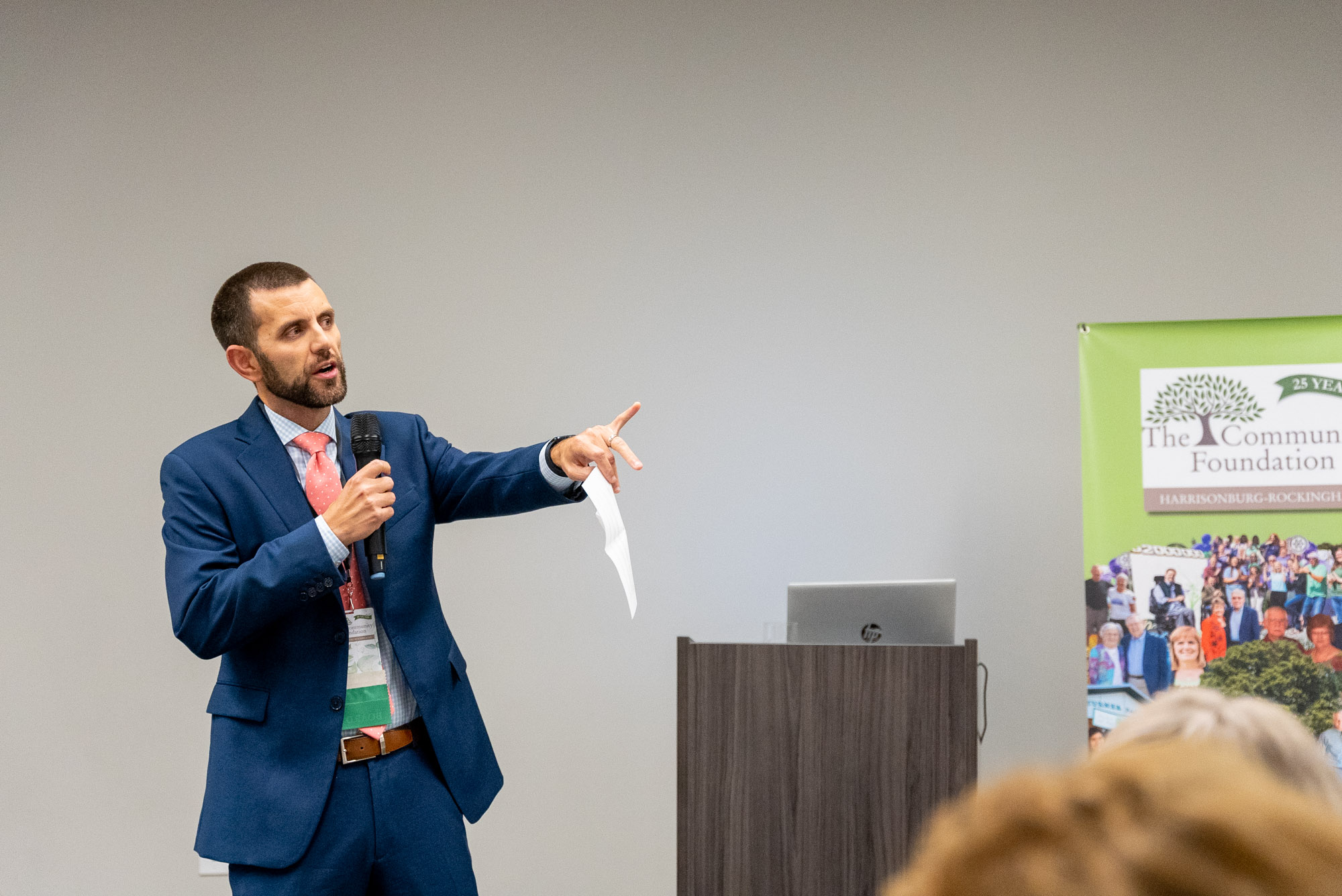
Photo: Kevin Flint, board chair, speaks during the 25th anniversary celebration for The Community Foundation of Harrisonburg and Rockingham in 2023.

Most people don’t know that community foundations are required to have a board of directors comprised of local residents. These representatives direct the foundation’s work, investing themselves and their expertise through the philanthropic initiatives that support and benefit the community.

The relationship between the community foundation’s board members, staff, donors and the residents they represent is a “win-win for everyone,” says Revlan Hill, executive director of The Community Foundation of Harrisonburg and Rockingham.

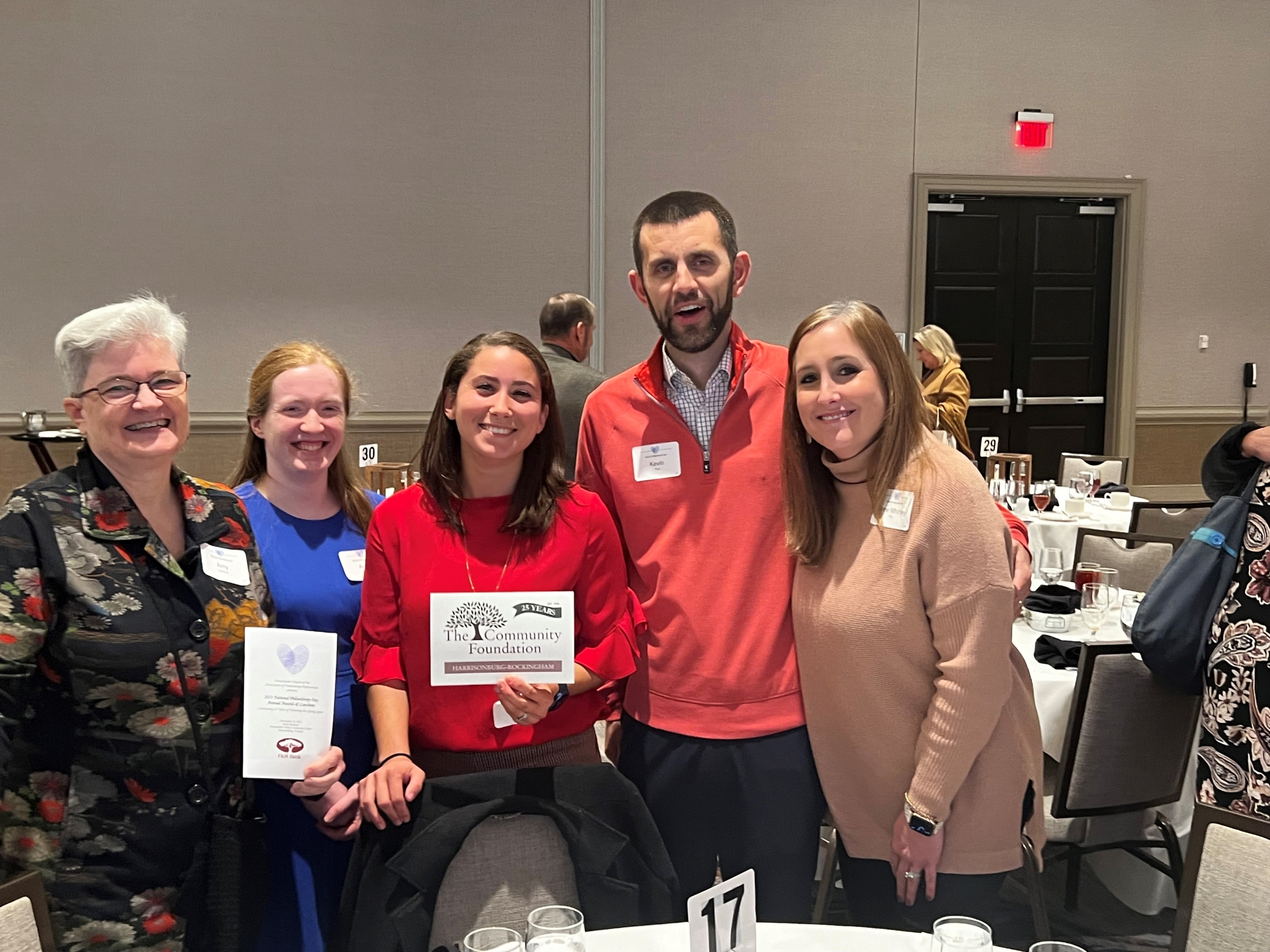
Board chair Kevin Flint with staff at a 2023 event.

That dynamic initially attracted professional advisor Kevin Flint, and it kept him learning, growing and giving back as he contributed to the governance and investment committees, and held vice chair and chair roles. Now, after 10 years on the board, the outgoing board chair ends his tenure with the foundation June 30.

“This place we call home has nurtured and supported me, so I feel compelled to reciprocate by working to enrich our community,” Flint said. “My involvement with TCFHR has helped me understand the real and growing needs across our region, and supporting the foundation means helping to meet those needs in lasting, strategic ways. That’s been a joy to be a part of.”

In addition to a background in commercial banking, community engagement, and portfolio management, Flint has brought to his foundation work extensive experience in advisory roles with the local government. He currently serves on the county’s Economic Development Authority and Planning Commission and spent more than seven years on the Social Services advisory board. He is also an adjunct faculty member with James Madison University’s College of Business.

“All of our board members bring an expertise and a connection to the work of the community foundation, but Kevin really applied himself to learning more,” Hill said. “He has a genuine love for TCFHR, and that has made a real difference in how we’ve progressed and grown over the past ten years. Kevin has been an exceptional chair during a time of growth and challenge.”

A measure of the organization’s growth can be seen in one statistic: In 2016, outgoing grants and scholarships totaled $2.7 million. In 2024, that number exceeded $6.8 million. Behind that number is a major growth in assets — from $31.9 million to $87.9 million — and a variety of challenges that accompany such growth.

“I have also appreciated Kevin’s positive and generous spirit and his wise counsel on so many matters over these years,” said Hill. “He brings a tremendous amount of wisdom and clarity, no matter the circumstances, and he’s always shown a great deal of care and support to me and to the work of the foundation in the most difficult of situations.”

Kevin Flint, board chair, steps down June 30 after 10 years of service to The Community Foundation of Harrisonburg and Rockingham.

She remembers that Flint’s acumen and approach were instrumental in bringing on a large agency fund and in handling several unusual matters that required additional legal and financial expertise.

Among Flint’s highlights are the foundation’s crucial management of relief funds through the COVID-19 pandemic, the expansion of its asset portfolio and correlated grants capacity, and the addition of two initiatives. The Great Community Give has grown into the region’s major giving day; just a few months ago, the event raised a record high $2.2 million for nearly 150 area nonprofits. TCFHR also hosts the Dolly Parton’s Imagination Library program, enrolling 40% of the area’s children.

“I’ve also enjoyed seeing firsthand how the foundation’s partnerships with local professionals have helped donors align their giving with their values in thoughtful, tax-strategic ways,” he said.

Flint says he will always value the relationships he’s built over the years with fellow board members, Hill and the foundation staff.

Looking ahead, Flint hopes to see more visibility and an increased understanding of how much the community foundation offers to the community. “Beyond the initiatives, the foundation offers so much more through endowments, scholarships, and donor-advised funds. TCF is a trusted partner for anyone looking to make a lasting charitable impact, and I want more people to know that.”

Vice chair Cynthia Prieto’s two-year term as board chair begins July 1.


It’s an Emory & Henry alumni reunion every time this scholarship committee meets

PHOTO: Members of the Emory & Henry University Scholarship committee at their April meeting, the 10th anniversary of the scholarship. All are alumni and current residents of the Harrisonburg and Rockingham County area. Standing, from left: Jay Webb, Sid Smith, scholarship founder David Driver, Olivia Haimani, Karen Ford. Seated, from left: Kate Nardi, Amanda Nott.

Every year, committee members meet to interview candidates for the Emory & Henry University Scholarship and every year, that meeting is something of a reunion.

Members of the selection committee — all E & H graduates and current city or county residents — are scholarship founder David W. Driver, Karen Ford, Olivia Haimani, Kate Nardi, Amanda Nott, Sid Smith, and Jay Webb.

Driver, a 1970 alumnus, started the scholarship 10 years ago with the goal of “providing local students the opportunity to explore the benefits of a smaller university community.”

The scholarship has provided 24 grants for a total of $33,500.

The 2025 scholarship was awarded to Beau Baylor, a senior from Turner Ashby High School, Dayton, Va.
Candidates for the annual award/s must be from any high school in Harrisonburg, Rockingham County, or Augusta County and meet the following further criteria: a 2.5 minimum GPA, community involvement, and demonstration of good character, determination, and leadership qualities.
Contributions to this permanent endowment will benefit Valley students in perpetuity. Click here to donate.

Bowman Scholar earns honors at Blue Ridge, will study business at JMU

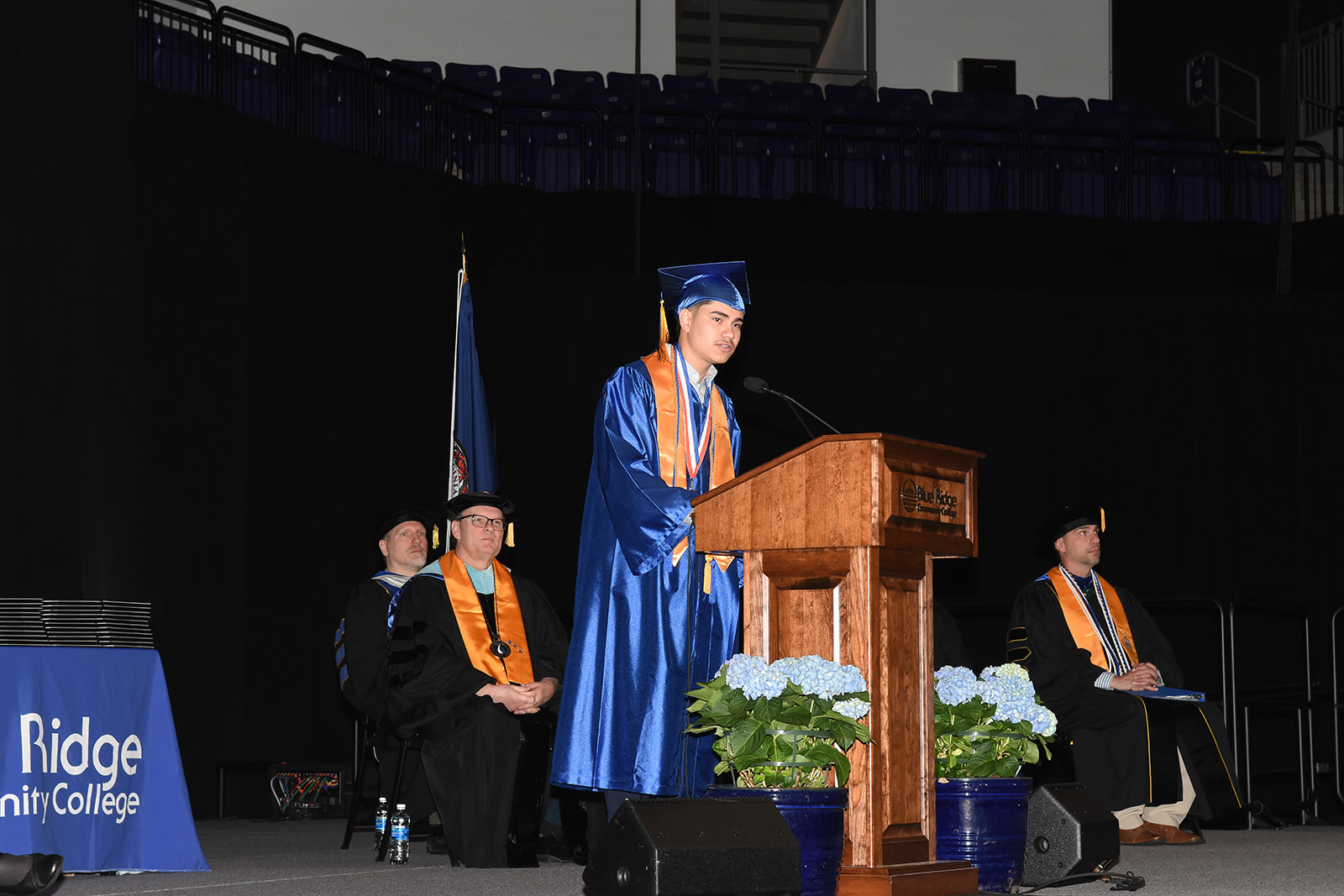
Fernando Sagastume, a 2023 Harrisonburg High alum, was the student speaker during the May 10 Blue Ridge Community College Commencement ceremony. (Courtesy of Gitchells Photography)

Photo caption: Bowman Scholar Fernando Sagastume holds his diploma from Blue Ridge Community College after the May 10 Commencement, with (from left) brother Bryan, parents Sandra and Carlos, and sister Hailey. (Courtesy photo)

Fernando Sagastume’s message to his fellow graduates of Blue Ridge Community College was about something he’s practiced since childhood: Asking for help.

“Asking for help doesn’t make you less smart,” he said, summarizing his May 10 Commencement address. “It makes you more knowledgeable. None of us start off knowing everything, but the challenges we face lead to both personal and professional growth.”

This simple but humble action of asking for help has empowered Fernando’s success, from learning two languages as a child, joining the college preparatory Advancement Via Individual Determination (AVID) program at Harrisonburg High School, applying for and winning college scholarships, and helping his family’s business grow.

“Fernando is currently one of our most impressive students,” said BRCC’s president, Dr. John Downey. “I’m impressed not only by his maturity and academic success at Blue Ridge, but also by his leadership as a young person in the Harrisonburg community, serving on boards and volunteering his time, all while helping to run his family’s roofing business.”

Fernando serves on the board of directors of On the Road Collaborative and on the recruitment and retention subcommittee of the HHS AVID program. At BRCC, he was a member of Phi Theta Kappa International Honor Society, and was recognized on the All-Virginia Academic Team.

The 20-year-old serves as the chief administrative officer at Highest Roofing and Exteriors, where he has played a key role in legal matters, insurance, marketing and sales since 2019.

Add another distinction to that long list.

“Fernando is the fifth Samuel R. Bowman II Scholar to transfer to James Madison University, and based on his pattern of top academic performance, he’ll be the third Bowman Scholar to graduate from JMU,” said Ann Siciliano, senior director of scholarships and grants at The Community Foundation of Harrisonburg and Rockingham.

The Bowman Scholarship was started by Samuel Bowman, a local farmer who was touched and inspired by the work ethic, generosity, and relationships of his many employees and wanted to help their children access higher education. The scholarship is for local students, usually first-generation, attending either Blue Ridge or James Madison University. It’s renewable, which means if recipients meet the criteria each year, they will receive additional funding.

While balancing work and studies, Fernando says he has been inspired by his family, particularly his parents Carlos and Sandra Sagastume, who have “always emphasized the importance of education and hard work.” Cousins Maria Alonso and Heiber Monroy have also “shown me what’s possible through sacrifice, persistence, and giving back to the community,” he said. In all that he does, he hopes to be a role model for his younger siblings, Bryan and Hailey.

Though he’s been awarded several scholarships as a result of his hard work, Fernando says the Bowman award is different. While one-time scholarships reward potential, earning a renewable scholarship symbolizes that and more.

The financial support as he’s transitioned through more and more academic challenge is a powerful message of “investment in my potential,” a unique award that shows “deep belief,” he says.

“I am beyond grateful to have received this opportunity, and it’s one I will take advantage of,” he said. “That faith and ongoing support is something I value in my education and will value forever.”

Editor’s note: We’re pleased to report that Bowman Scholar Lindsey Ruvalcaba also graduated from BRCC last weekend with academic honors. Both she and fellow Harrisonburg High grad Fernando Sagastume were featured in local media coverage of Commencement. After a gap year, she plans to attend JMU to study biotechnology.

Seven data points from Great Community Give 2025 and why they create hope for the future

The following was published in the Monday, May 12 Daily News-Record

On April 16, during the Great Community Give, Harrisonburg and Rockingham County beat the odds.

What do we hear about charitable giving in 2025? Overall donations are down, fewer individuals and businesses are giving, fewer citizens are involved in service or faith organizations, and the younger generation is trending away from charitable endeavors like donating and volunteering.

View the GCG photo album.

Here’s what the 2025 Great Community Give teaches us:

Our residents are incredibly generous. For the second consecutive year, donors to the Great Community Give contributed more than $2 million. You helped raise our highest-ever one-day total: an astonishing $2, 212, 649, an increase of $96,609 over 2024.

We have a thriving nonprofit sector in the Shenandoah Valley. Some of the 147 organizations participating in the Great Community Give are independent nonprofits, but many are linked to community service or faith-based organizations. That’s a lot of local citizens working to solve local problems

Our business community cares deeply about and is financially invested in what happens here. Forty-two businesses contributed to a $76,000 prize pool and 100 percent of that went to 38 nonprofits that won hourly contests. Between Harrisonburg Media Group, iHeart Radio, WHSV-3 and the Daily News-Record, nonprofits received countless hours of interviews and public service messaging.

We can glean more positives from this year’s data, too:

  • More donors self-reported giving for the first time to an organization.
  • More individuals registered to fundraise for a specific organization and more of these peer-to-peer fundraisers (or P2P for short) followed through on their fundraising promise.
  • P2P fundraisers made a huge difference during GCG 2025. They helped their organizations raise an average of $29,900— more than double what those without fundraisers raised. These folks were also responsible for raising $71,210 more than last year (for a total of $155,895).
  • And one more important detail: Donors using digital wallet options increased, which suggests a rise in donors ages 15-58 — the demographic that most prefers this option.

Everyone who participated in Great Community Give, including our sponsors, nonprofit partners, and the team at The Community Foundation of Harrisonburg and Rockingham, can look at these conclusions with immense gratitude. Thank you for joining in a day where we envision positive change, a transformed world, and belief in each other.

And yes, let’s keep the spirit of the Great Community Give going throughout the year!

Revlan Hill

Executive Director

JMU finance grad finishes TCF internship and heads to Smithfield Foods

I saw the real-world impact tied to my work and enjoyed solving problems that didn’t have a black-and-white answer.

– Nick Marks, JMU ‘25

With supporting educational opportunities among its strategic priorities, The Community Foundation of Harrisonburg and Rockingham currently hosts a paid internship program in accounting – with plans to add opportunities in communications and marketing.

Nick Marks, a senior finance major at James Madison University, came on board in fall 2024 and decided to stay on through spring 2025. Marks leaves having gained “a ton of knowledge in accounting,” which he believes helped him through a rigorous application process that culminated in a job offer in early 2025.

“Accounting is the language of business, so having a strong background in accounting is very sought-after for a finance role,” he said.

TCFHR’s director of accounting, Anna Wagner, was his supervisor.

“Working with Anna, who has impressive accounting experience, was valuable because she was dedicated to helping me develop as a professional, not just getting the work done,” Marks said. “Having one-on-one exposure to the director of accounting is super valuable, and likely very hard to find with an internship.”

After graduation, Marks will join Smithfield Foods in their Career Foundations program, a two-year experience which allows him to rotate through aspects of the corporate structure while developing professional skills, honing his corporate finance skills, and learning the core business of the company.

Marks is a graduate of Ocean Lakes High School in Virginia Beach, so the move to southeast Virginia sends him a bit closer to home.

Though he always had the goal of working in corporate finance, Marks says the principles of business for a nonprofit are similar. He’s come away with an increased appreciation for the work of the community foundation, its impact, and the reach of its work.

“Nick has been a great support for our team, always providing quality results for any new task he takes on,” Wagner said. “All the skills that I’ve seen Nick cultivate throughout the internship will contribute to his future success in corporate finance. I hope what he has learned from the philanthropic sector will help him continue to see how the world of business can partner with nonprofits as they make a difference in their communities. Congratulations on a well-earned graduation!”

In addition to his TCF internship, Marks worked as a student venture associate at the Bluestone Seed Fund, a donor-backed, equity investment vehicle that invests in early-stage JMU-affiliated startups through a competitive pitch process. The fund operates through the Gilliam Center for Entrepreneurship in JMU’s College of Business.

$2.2 MILLION RAISED: Great Community Give meets two historic goals

The 2025 Great Community Give on April 16 met all goals, raising $2.2 million for 147 local nonprofits and exceeding the $11 million mark for total dollars raised.

The online giving event, hosted by The Community Foundation of Harrisonburg and Rockingham, began in 2018.

View the GCG photo album.


“We’re so grateful to the generosity of more than 7,600 donors and 46 sponsors that made this day possible,” said TCFHR Executive Director Revlan Hill. “Especially now, when many area nonprofits are dealing with funding crunches, this event is so important. We’re thrilled to see more new donors and more residents fundraising on behalf of their organizations, both data points which say a lot of about who we are as a community.”

Read Revlan Hill’s letter of thanks to the community.


The total amount raised by the 8 p.m. deadline was $2,212,649 — approximately $96,609 more than the 2024 total.

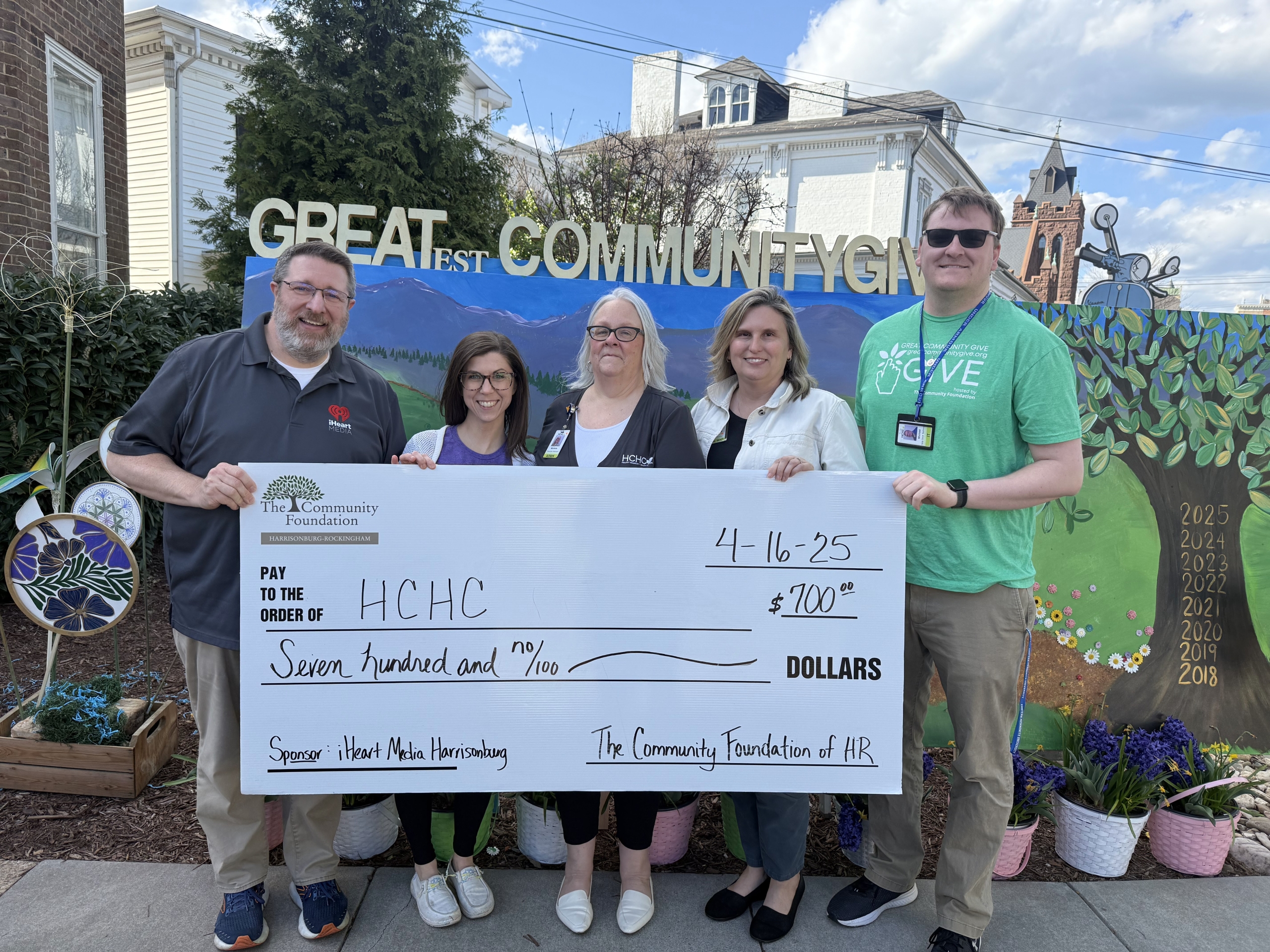
Sponsor iHeart Media’s Chris Carmichael (left) with staff and supporters of HCHC. The health clinic won an hourly prize during the April 16 Great Community Give.

The number of Mobilepay users rose significantly, which may signal an increase in younger donors – one of the event’s target audiences.

Lauren Jefferson, director of programs and marketing, pointed out two other interesting stats that show how committed local residents are to helping the nonprofits in the area.

The number of organizations supported by committed peer-to-peer (P2P) fundraisers grew by 79%, with 15% more of these fundraisers following through on their promise to raise money for the organization. This year’s donors responded positively to these individuals and their funding requests, with an 108% increase in the number of donors. Organizations that participated with fundraisers raised an average of $28,900. Organizations that did not have fundraisers logged $11,400.

Matches and challenges helped raise $14,500 more than 2024 (for a total of $343,661).  About 510 more donations were made to support a match or challenge this year. Organizations using matches or challenges raised an average of $38,500; those that did not use a match or challenge raised an average of $9,300.

Media coverage and support helped to spread the word about the event, said Jefferson. “We estimate more than 30 hours of media coverage from our platinum sponsor Harrisonburg Media Group, joined by iHeart Radio, WHSV TV-3, and the Daily News-Record.”

Hourly contests and leaderboard prizes helped 39 nonprofits in three size categories win cash prizes to augment their totals. For more information, visit www.greatcommunitygive.org/prizes

Weighing the options: Private foundation or donor-advised fund?

When you’re working on the charitable components of a client’s estate or financial plan, one of the first areas you’ll likely explore is the structure. Certainly you are familiar with both private foundations and donor-advised funds as useful charitable giving tools. Before you jump into one or the other for a particular client, though, it’s important to review the similarities and differences between the two so that you can best achieve your client’s goals. 

To help you evaluate a client’s options, here are three common myths about the differences between private foundations and donor-advised funds.

Myth #1: Donor-advised funds are all the same and only private foundations can be customized

Private foundations will always differ from donor-advised funds in important ways, not only because of their status as separate legal entities and the deductibility rules for gifts to these entities, but also because of the opportunities to customize governance. But it is a mistake to assume that a donor-advised fund is a cookie-cutter vehicle. Indeed, “donor-advised fund” is simply a term used to describe the structure of a fund and its relationship with a sponsoring organization such as a community foundation. The donor-advised fund vehicle itself is extremely flexible. Here’s why:

–Donor-advised funds are popular because they allow your client to make a tax-deductible transfer of cash or marketable securities that is immediately eligible for a charitable deduction. Then, your client can recommend gifts to favorite charities from the fund when the time is right. 

–A donor-advised fund at the community foundation is frequently a more effective choice than a donor-advised fund offered through a financial institution. At a community foundation, your client is part of a community of giving and has opportunities to collaborate with other donors who share similar interests. Plus, the community foundation is itself local and is deeply knowledgeable about the needs of our region and the nonprofits meeting those needs. 

–The community foundation can work with you and your client to build a charitable giving plan that extends for multiple future generations. That is because the team at the community foundation supports your clients in strategic grant making, family philanthropy, and opportunities to learn about local issues and nonprofits making a difference. 

Myth #2: Deciding whether to establish a donor-advised fund or a private foundation mostly depends on size

The size of a donor-advised fund, like the size of a private foundation, is unlimited. The United States’ largest private foundations are valued well into the billions of dollars. Information about private foundations, ironically, is not so private. The Internal Revenue Service provides public access to private foundations’ Form 990 tax returns. That is not the case for individual donor-advised funds.

Similarly, donor-advised funds are not subject to an upper limit. Although information on the asset size of individual donor-advised funds is not publicly available, anecdotal information indicates that some donor-advised funds’ assets may total in the billions of dollars.

Indeed, a donor-advised fund of any size can be an effective alternative to a private foundation, thanks to fewer expenses to establish and maintain, maximum tax benefits (higher deductibility limitations and fair market valuation for contributing hard-to-value assets), no excise taxes, and confidentiality (including the ability to grant anonymously to charities).

The net-net here is that the decision of whether to establish a donor-advised fund or a private foundation–or both–is much less a function of size than it is other factors that are tied more closely to the objectives a client is trying to achieve. 

Myth #3: Donor-advised funds and private foundations are mutually exclusive

Make sure you’re aware of the benefits of using both a donor-advised fund and a private foundation to accomplish clients’ charitable goals. For example:

–Donor-advised funds can help meet the need for anonymity in certain grants, which is typically difficult using a private foundation on its own.

–A donor-advised fund can receive a client’s gifts of highly-appreciated, nonmarketable assets such as closely-held stock and real estate, and benefit from favorable tax deduction rules not available for gifts to a private foundation.

–An integrated donor-advised fund and private foundation approach can help a client balance and diversify investment and distribution strategies to ensure that giving to important causes remains steady even in market downturns.

Some private foundations are even considering transferring their assets to a donor-advised fund at the community foundation to carry on the foundation’s mission. Terminating a private foundation and consolidating giving through a donor-advised fund is sometimes the best alternative for a client when the day-to-day management and administration of the private foundation has become more time-consuming than expected and is taking time and focus away from nonprofits, the community, and making grants. 

Along these lines, some families find that the tax rules related to investments, distributions, and “self-dealing” have become harder to navigate and are perhaps even preventing the family from maximizing tax benefits of charitable giving. Finally, the administrative load of managing a private foundation sometimes becomes overwhelming, especially if the family members who handled these functions initially have retired, passed away, or simply become busy with other projects.

The bottom line here is that we encourage you to reach out to the team at the community foundation any time you are evaluating how to structure a charitable giving plan to achieve both your client’s charitable goals and financial goals. Our team is here to help. In many cases, the community foundation’s tools and services are a great fit for your client’s needs. If not, we will point you in the right direction.

Area NPOs report disruption, uncertainty around federal funding freeze

Twenty-one area organizations reported a range of effects from last month’s funding freeze, with a few respondents projected debilitating revenue losses of up to 85 percent.

The data came from a survey sent to 150 area nonprofit leaders by The Community Foundation of Harrisonburg and Rockingham.

Seventeen organizations reported some reduction in services related to the freeze.

“Even as we acknowledge that this situation is fluid and changing day by day, the information provides early indicators about the larger impacts of the federal funding freeze,” said Revlan Hill, executive director. “Some organizations still don’t know the full effect.”

Hill was interviewed by WHSV TV-3 and WSVA Radio about the survey results, as well as about what she was hearing from area nonprofit leaders in the immediate aftermath of the cuts.

Watch the WHSV TV-3 interview.

Listen to the radio show.

TCFHR did not gain permission to publicly share specifics related to responding organizations, but staff did reach back out when an opportunity arose to meet with city and county officials. “We chose to speak in generalities unless we had permission to give more specifics,” Hill said.

In Summary

Some takeaways from the survey:

—Many organizations reported needing to decrease their services because of reductions in staffing, at the same time as they were seeing an increase in the need for services from new and established clients.

—Reductions in funding, realized or anticipated, were also leading to higher barriers to entry for clients; for example, benefits like free materials or free/lower processing fees were at risk.

—At least one organization reported losing one full-time staff member, while others anticipated the need to substantially reduce staffing. At least two organizations anticipated needing to shut down operations because of the loss of staffing.

—Concerns about staff wellbeing, stability and commitment are real, said one respondent whose team will face an “overwhelming backlog” if funding does resume.

“These kind of disruptions also lead to low morale and anxiety, along with an increased or even new workload,” Hill said. “The nonprofit world has always been a challenging space to work in, and staff deeply care about providing the best services to those they are serving. I can imagine many people are more anxious and concerned in their day-to-day work right now.”

—Interrupted or unstable funding can also mean the loss of several years of research, partnership, and collaboration, said one respondent, naming that the third year of a five-year initiative would be funded but not the final two years.

—Some organizations are leaning on already established partnerships or collaborations to synergize services – an innovative and positive problem-solving step, but one that takes time and energy. On the other hand, the sapping of resources and energy curtails strategic planning and reinforces the “hunker-down” mentality.

What’s Next?

TCFHR has used survey information to inform inquiring donors looking to prioritize local charities in need. Another stakeholder survey may be in order to continue to track effects, Hill said, as well as better quantify the effects of federal dollars on Shenandoah Valley communities.

TCHFR’s annual grant cycle opens July 1, and grantmaking strategies will invariably include discussion about affects on applying organizations.

With the April 16 Great Community Give just around the corner, publicity efforts for this major online giving day have intensified.

Last year’s event helped raise $2.2 million dollars. While the giving landscape may have shifted with so many organizations in need, there’s a new urgency to this year’s event, Hill said. “Contributions are always important to a nonprofit organization but they almost seem like they’re more important right now. We hope Great Community Give attracts even more donors this year.”


Eighth annual Great Community Give set to surpass historic giving mark

Great Community Give helped the Explore More Discovery Museum fund a summer teen internship program. (Courtesy photo)

Approximately 149 nonprofits serving Harrisonburg and Rockingham County will participate in the eighth annual Great Community Give on Wednesday, April 16, 2025. The online giving day, hosted by The Community Foundation of Harrisonburg and Rockingham (TCFHR), has raised more than $9.2 million since the first year.

If this year’s giving follows past patterns, the $10 million mark will be reached by 10 a.m.

“When The Community Foundation started this event eight years ago, we never dreamed that our community would raise $10 million dollars for area nonprofits,” said Revlan Hill, executive director. “Our thanks go out to our wonderful team of sponsors, volunteers, and of course, the donors who come back every year to make this event so successful.”

Goals for this year include raising $2 million and increasing the number of donors.

Silk Moth Stage used Great Community Give funding to increase audience accessibility. Their innovative efforts have offered a model to other theater groups. Interpreter Melissa Black (right) signs next the stage during a performance of “Underneath the Lintel” in May 2024 at Silk Moth Stage in Bridgewater. (Courtesy photo)

“Last year’s total of $2.2 million was raised with the help of more than 7,600 donors, and we’d love to surpass both of those numbers,” said Lauren Jefferson, director of programs and marketing at TCFHR. “We’d also love to grow our reach to people that may not know about the event and are giving for the first time. For each of the past two years, we’ve had about 2,200 donors who are totally new to the event and have never donated before. It would be fun to see that number rise!”

Giving is as easy as visiting www.greatcommunitygive.org, searching for an organization or a cause to support, and putting a donation into a virtual cart. Donors can support multiple organizations efficiently.

“Supporting our local nonprofits and the valuable services they offer our community members is more important than ever,” Jefferson said. “We encourage donors to help us spread the word about this event and join in a really unique day that celebrates all the hard work being done to make our community a better, healthier place.”

Generous sponsors contribute to a prize pool of approximately $76,000, all of which goes back to the nonprofits through hourly contests and random drawings.

The day kicks off at 6 a.m. and ends at 8 p.m. Giving isn’t limited to just one day: Donors can also give cash or checks directly to the nonprofits from April 2-15.

Here’s how last year’s donations helped four organizations:

  • Explore More Discovery Museum funded updates to their creative studio workshop, their teen internship program, Career Saturdays with area professionals, and preschool programs.
  • Village to Village hosted a week-long free camp for more than 60 refugee students  who built relationships through workshops, games and meals with 50 community volunteers.
  • Silk Moth Stage, a theater that has pioneered accessibility in Virginia, used some of the donation from Great Community Give to provide American Sign Language interpretation at several

    Village to Village used GCG funding to fund a summer camp for refugee children. (Courtesy photo)

    performances. “Other theaters have reached out to me for advice about adding ASL and other accessibility practices since they saw how positive it was for Silk Moth Stage,” said Aili Huber, artistic director.

  • Still Meadows Enrichment Center and Camp, a therapeutic riding center and outdoor facility, used the funds from GCG to maintain railings on the accessible treehouse; purchase day camp supplies; and expand their riding activities with new equipment.